Creatures
Pay the cost and put the creature into any empty lane you choose. If every lane is full, you cannot play it.
A creature is not ready the turn you play it unless it has Rush. Mark it somehow until the start of your next turn.
Physical play · Rise of the Pack
Two players. Cards on the table. No screen.
If a printed card contradicts this page, follow the card.
01
Two players, sitting across the table.
Table space: five creature lanes and five spell/trap spaces per player, plus a deck pile and a graveyard pile. Optional markers help for summoning sickness, “already attacked,” Freeze, and Taunt.
02
Reduce the enemy Hero to 0 HP. You win. They lose.
Only Heroes have a life total that wins the game. Creature fights are all-or-nothing — a body is either still on the table or it is in the graveyard.
If both Heroes would hit 0 at the same time, the game is a draw.
03
Shuffle thoroughly before every game. The deck sits face-down. The graveyard sits face-up next to it.
04
Each player has two rows in front of them, closer to the middle of the table first:
Line the creature rows so each of your lanes sits directly across from one of theirs. Left and right neighbors are adjacent. Diagonal is not adjacent.
Hand stays in hand. Maximum hand size is 10. If you would draw past 10, the extra card goes to the graveyard.
05
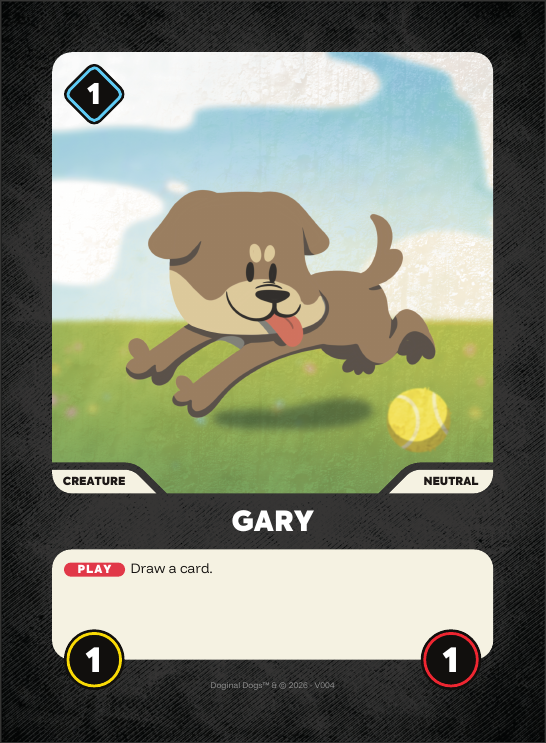
Top-left. Pay this much mana to play the card.
Creature, Spell, or Trap.
Crown, Bow, Wizard, Zombie, Pirate, or Neutral.
Bottom-left Attack, bottom-right HP. Creatures only.
What the card does. Keywords and pills (Play, Passive, Haunt) print here.
06
Once during the game, when the second player plays a card, they may spend the Coin to pay 1 extra mana for that card. The Coin does not raise their mana cap. After it is used, it is gone.
07
Turns alternate. Unspent mana does not carry over.
Mana cap +1, max 10. Refill to that cap. Turn 1 is 1 mana.
Draw 1. Empty deck: fatigue — 1, then 2, then 3 damage, and so on.
Start-of-turn effects, left to right, then lasting spells oldest first.
Play creatures, cast spells, set traps, attack — in any order you can pay for.
End-of-turn effects left to right. Temporary effects wear off. Pass.
08
Pay the cost and put the creature into any empty lane you choose. If every lane is full, you cannot play it.
A creature is not ready the turn you play it unless it has Rush. Mark it somehow until the start of your next turn.
Most spells resolve now, then go to the graveyard. Lasting Passive spells stay in your spell row until something destroys them.
If a spell needs a target and you have no legal target, you cannot play it.
Pay the cost and set the trap face-down in an empty spell-row space. It stays secret until it fires. A trap cannot spring the turn you set it.
09
Ready creatures may attack an enemy creature or the enemy Hero. After a creature attacks, it is spent for the turn unless it has Fury.
Creatures do not chip each other. A creature fight is legal only if somebody dies.
You may send a creature at an enemy creature only if at least one of these is true:
If neither body would die, the attack is illegal. Do not tap, do not deal damage, do not “poke.” Nothing happens because you cannot declare it.
Legal
3 Attack / 3 HP vs 3 HP / 3 Attack
Both die. Equal Attack kills.
Illegal
2 Attack / 4 HP vs 3 HP / 2 Attack
Nobody dies. You cannot attack that body.
Legal
2 Attack / 2 HP vs 3 HP / 2 Attack
You die. They live. Suicide is allowed.
Legal
1 Attack with Poison vs Any HP
Poison destroys the body you fight.
You may send two or more of your ready creatures at one enemy creature as a single attack. Add their Attack together for the kill-gate. If the stack is legal, the defender strikes back at each of your attackers separately.
A ready creature may attack the enemy Hero and deal its Attack as damage. This is real numbered damage — Heroes do take chip damage.
You cannot hit the Hero the turn a creature is played, even with Rush. Rush only lets that creature attack other creatures the turn it enters.
If the enemy has any Taunt creature, you must attack a Taunt. Face is closed. Non-Taunt bodies are closed until every Taunt is gone.
10
11
Cards print when they fire. Resolve one creature fully before moving to the next, left to right.
There is no shared response stack. Resolve what the card says, in the order it prints, then continue.
12
If several of your traps could fire on the same moment, resolve them left to right. A trap that stops the action (counter, prevent, negate) ends that wave. Later traps stay set.
Passive spells that stay in play occupy a spell-row space and keep working until they are destroyed.
13
Crown, Bow, Wizard, Zombie, and Pirate are the five classes. Neutral cards sit in any deck.
Walls, Taunt, healing, and the long game.
Play-effect chains and movement.
Spells, end-of-turn value, and answers.
Haunt payoffs, sacrifice, and the graveyard.
Fast boards and death payouts.
Shared tools and hate cards that fit any pack.
14
Do not invent Attack, HP, costs, or card text. If a card is unclear, read it aloud, follow the words, and keep playing.